IMACS: Seventy Years of Advancing Mathematics, Computation, and Simulation
The International Association for Mathematics and Computers in Simulation (IMACS) traces its origins to 1955, when the first International Conference on Analog Computation was held at the Université Libre de Bruxelles (ULB). The success of this pioneering event, which brought together scientists and engineers from across Europe, the United States, the Soviet Union, and Japan, highlighted the need for a permanent platform to foster collaboration in the emerging fields of computation and simulation.
This led to the establishment, in 1956, of the Association Internationale pour le Calcul Analogique (AICA) under Belgian law. Under the leadership of Jean Hoffmann, AICA promoted international cooperation in analog computation and, subsequently, in the rapidly growing field of digital computing. His successor, Robert Vichnevetsky, guided the organization through a period of significant transformation that culminated in the creation of IMACS in 1976. This evolution reflected not only the transition from analog to digital paradigms but also the increasing importance of mathematics as a foundation of computational science and simulation.
The establishment of IMACS marked the beginning of a broader mission: to advance mathematical and computational methods, encourage interdisciplinary collaboration, and support the worldwide dissemination of knowledge in modeling, simulation, and scientific computing.
For more information about IMACS, including its history, activities, publications, and conferences, readers are invited to visit the official website : https://www.imacs-online.eu/
A Brief History of the IMACS World Congress
The origine of IMACS World Congresses can be traced back to 1955, when the first International Conference on Analog Computation was held in Brussels, Belgium (ULB). This meeting led to the creation of AICA (International Association for Analog Computation) in 1956.
Professor Robert Vichnevetsky, guided the organization through a period of transformation, culminating into the IMACS birth in 1976, a change that reflected the shift from analog to digital paradigms and also the expanding role of mathematics in computational sciences.
Over the decades, the IMACS World Congress has become a major international forumbringing together researchers, engineers, practitioners, and industrial partners from around the world. The congress provides an opportunity to exchange ideas, present recent advances, and foster collaborations across a wide range of scientific and engineering disciplines.
Previous IMACS World Congresses
- 1955 – Brussels, Belgium
- 1958 – Strasbourg, France
- 1961 – Opatija, Yugoslavia
- 1964 – Brighton, United Kingdom
- 1967 – Lausanne, Switzerland
- 1970 – Munich, Germany
- 1973 – Prague, Czechoslovakia
- 1976 – Delft, The Netherlands
- 1979 – Sorrento, Italy
- 1982 – Montreal, Canada
- 1985 – Oslo, Norway
- 1988 – Paris, France
- 1991 – Dublin, Ireland
- 1994 – Atlanta, USA
- 1997 – Berlin, Germany
- 2000 – Lausanne, Switzerland
- 2005 – Paris, France
- 2009 – Cairns, Australia / Athens, GA, USA
- 2013 – San Lorenzo de El Escorial (Madrid), Spain
- 2016 – Xiamen, China
- 2023 – Rome, Italy
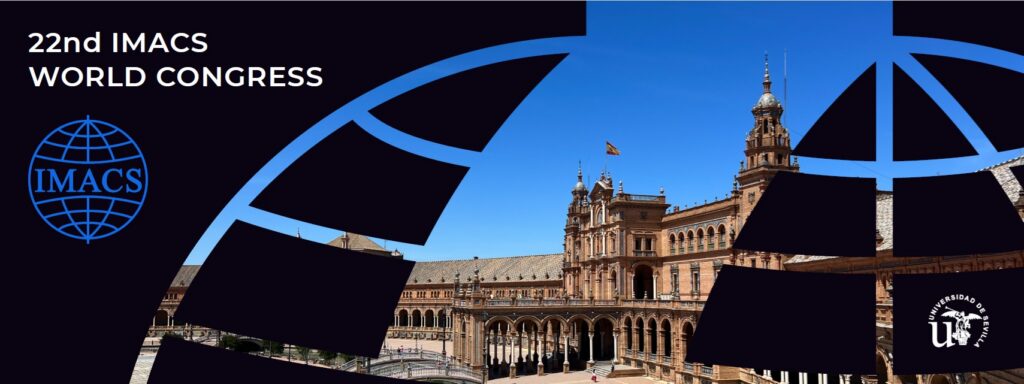
The 2027 edition in Seville continues this long-standing tradition of excellence and international collaboration, bringing together the global IMACS community to address current and emerging challenges in mathematics, scientific computing, simulation, and their applications.